History of “Rise of the Golden Cobra” and Piankhy’s Stella
Rise of the Golden Cobra deals with a true event, one of ancient Egypt’s largest wars. The original account of the conflict was by King Piankhy of Kush, the leader of this invasion of Egypt. He told of the campaign on a slab of granite more than six feet high. The slab, covered on both sides with Egyptian hieroglyphic writing, was unearthed in Sudan by American archaeologists in 1862. Its colorful, blow-by-blow description of the war is a little-recognized masterpiece of ancient literature. The stela, as the stone narrative is called, and other ancient texts provide the basis for much of the Rise of the Golden Cobra’s story.
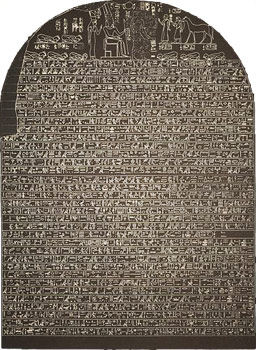
Although he was an invader of Egypt, Piankhy (also known as Piye) was no imperialist. His goal was not to subjugate or loot Egypt but to protect it from destruction at the hands of the great superpower of that era, Assyria. Located in what is today Iraq, Assyria had amassed the largest empire the world had ever seen; it sought to invade Egypt, treasure house of the ancient world. Rise of the Golden Cobra takes a novel’s liberties in its dramatization of Kush’s great campaign, but its characterization of the merciful, horse-loving Piankhy is faithful to the stela.
The stela is on the left. In the scene chiseled at the top, the seated figure is the god Amon. Behind him is the mother deity, Mout. Standing originally in front of Amon was Piankhy; however, he has been erased (presumably by enemies who, long after his reign, invaded Kush). To the right is Nimlot’s wife and, leading a gift horse, Nimlot himself. The
crouching figures are defeated enemies.